


Wanda Maximoff and Phase 4 Storytelling
- Brooke D
- Feb 10, 2023
- 5 min read

Updated: Mar 15, 2023
Hi everyone! Today, I thought we'd take some time to look back and examine the start of Phase 4 in the MCU, with a focus on Wandavision and Wanda Maximoff.

The Impact of Wandavision
The show premiered over two years ago in January 2021. The pandemic threw a wrench in the original airing plans of Marvel's Phase 4 properties. Originally, the start was never meant to include Wandavision. Instead, Black Widow, followed by The Falcon and the Winter Soldier were meant as openers followed by Eternals and Shang-chi. Wandavision would have then premier months later in the spring of 2021.
Had the release played out as intended, I don't believe the impact of Wandavision would have landed the same. Of the Phase 4 films and shows I've gotten to watch, I truly believe Wandavision was the most groundbreaking. After Endgame, while unanticipated, there was a need for a break from superhero films. After a steady release of 2+ films a year for the past decade, the weight of Endgame being allowed the space to breathe was essential to allowing new Marvel fans (and old) to get themselves caught up with the films preceding.
There are some who disagree. Mariah Mayhugh from ScreenRant argues that "Phase 4 was meant to kick off the Multiverse Saga - which it did, albeit weakly." While I agree, Phase 4's overall concept is the multiverse, I would argue that's not why I tuned in every week to watch Wandavision, nor why I watched Multiverse of Madness, nor even why I continued watching the other Marvel series being released last year.

I believe Marvel has fundamentally changed their focus from plot-driven stories to character-driven ones and with that change, the need to fully immerse the audience, new and old, into unfamiliar territory (the Hex) as one of our first introductions to Phase 4 worked. It set a precedence for what we should expect moving forward: untraditional storytelling and character-driven arcs. This show would ultimately splinter the classic superhero genre we've been so entrenched in. While Thor Ragnorak explored a more comical side of superhero films in the Infinity Saga, I believe Wandavision opened the possibilities of exploring other genres within the superhero archetypes because of its use of its clever use of the "sitcom" and the evolution of that form of storytelling.
Wandavision paid homage to past sitcoms and while its action scenes did not disappoint, the real meat of the series landed with the building of suspense as more of Wanda's backstory was revealed. Had Phase 4 begun with The Falcon and the Winter Soldier, which I appreciate in its own right, I believe it would have lessened the impact of Wandavision. The period of time spent waiting to see what the MCU did next partnered with the uniqueness of Wandavision led to explosive success.
Wanda's Character Arc

Part of what makes Phase 4 stand out is that it finally addresses the moral line that divides heroes from villains. While there was discussion of morality in Captain America: Civil War, it did not blur the lines of right and wrong in the same manner as Wanda's villainous (?) arc.
Marvel is dedicated to exploring the fallout of everything that happened and the impact it had on its characters. [...] WandaVision reminds us the tragedy is still a fresh wound for the citizens of the MCU--one they’ll be dealing with for a long time.
While Marvel is known for their long-form storytelling, the focus in Phase 4 on the consequences of Thanos' snap is very well done, especially at a time in the world in which, much like The Blip, the effects of the pandemic were globally destructive. Millions of people lost their lives or were terribly ill. Others not suffering from the disease in place suffered a severe drop in mental health as quarantine stretched on. Seeing the focus of superheroes switch from an external struggle to an internal one, whether planned all along or not, resonated with viewers. Superheroes in this new phase are no longer untouchable beings. They experience the realities of grief and loss and with Wanda Maximoff particularly, they explored the grieving process in a way that kept viewers engaged and grounded in Wanda's arc.
Wandavision examines the complexities in the creation of the Hex, specifically the ways in which sitcoms were a crucial part of her upbringing. Each commercial ties back to her own trauma, whether it's the ticking watch or the remainder of the catastrophe she caused unintentionally in Civil War. Wanda's villain arc was so unlike anything we've seen from Marvel thus far. We are given Wandavision through her control.

In the second to last episode, we watch as Wanda is forced to relive the most traumatic events of her life -- from surviving the bombing of her childhood home to the contact with the infinity stone, which gave her her powers. We also see pieces falling on the Infinity Saga timeline of films that were not able to be explored such as Vision comforting Wanda in the Avenger's Tower after losing her brother and when Wanda breaks into S.W.O.R.D. to say her goodbyes to Vision. We also see the overwhelming grief that led to the creation of the Hex.
This begs the question: How far does justification take you in the case of Wanda's character? I sympathize with Wanda and while I can see the pain she caused, I don't believe she's the villain in Wandavision. Especially after she sacrificed her family to release those in the town. However, in DSMOM (Dr. Strange in the Multiverse of Madness), she fully takes on the role of the antagonist. Her killings are more brutal and the overall tone of the film is borderline horror (and is classified as such).
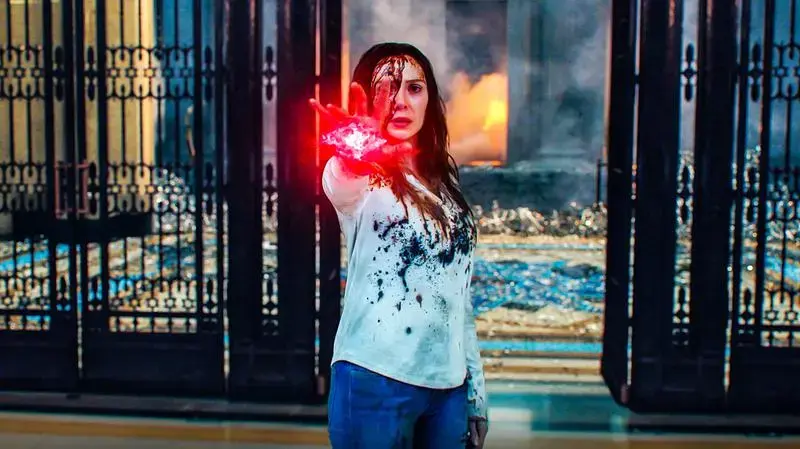
In DSMOM, there are fewer folks willing to defend Wanda's actions. While she didn't intend to cause pain in Wandavision, she openly slaughters many on screen in DSMOM, including those in The Sanctum Sanctorum as well as Captain Carter whom she uses the Captain America shield to slice through. Even Professor X in a scene of particular horror, has his head (for lack of a better word), exploded. It's in this film that Marvel explores the depths of Wanda's search for her family and the corrupt actions that come of it. By the end, she confronts her children and is forced to accept that her actions have caused them to fear her.
Also, the use of the Darkhold cannot be understated as we see its dark power in the form of Sinister Strange and eventually Dr. Strange himself when he dream-walks into the dead and receives a third eye at the end of it.
While Wanda caused mass destruction, she never used the immense power she was given to take over the world. She just wanted her family back, but does that justify her actions? Where do we draw the line when it comes to characters doing the wrong thing for (maybe) the right reasons? And finally, the most important question, who are the "good guys"?
Resources
Mayhugh, Mariah. “The MCU's Original Release Plan Could've Fixed Phase 4.” ScreenRant,
4 Dec. 2022, https://screenrant.com/mcu-phase-4-original-release-order-plan-fix/.
Yehl, Joshua. “How WandaVision Changed the MCU Forever.” IGN, IGN, 13 Mar. 2021,
https://www.ign.com/articles/how-wandavision-changes-the-mcu-forever.


Comments